
Conversational AI vs Chatbot: Which One Do You Actually Need?
Most business owners start their journey by searching for Conversational AI vs Chatbot, and that is exactly where the headache begins.
You know you need automation, something that talks to your customers while you sleep, but the pricing makes no sense. You ask two developers for quotes, and this happens:
- Developer A: “I can build you a chatbot for $500.”
- Developer B: “You actually need Conversational AI. That will cost around $5,000.”
Now you are confused. How can two tools that basically “chat with users” have a 10x price difference?
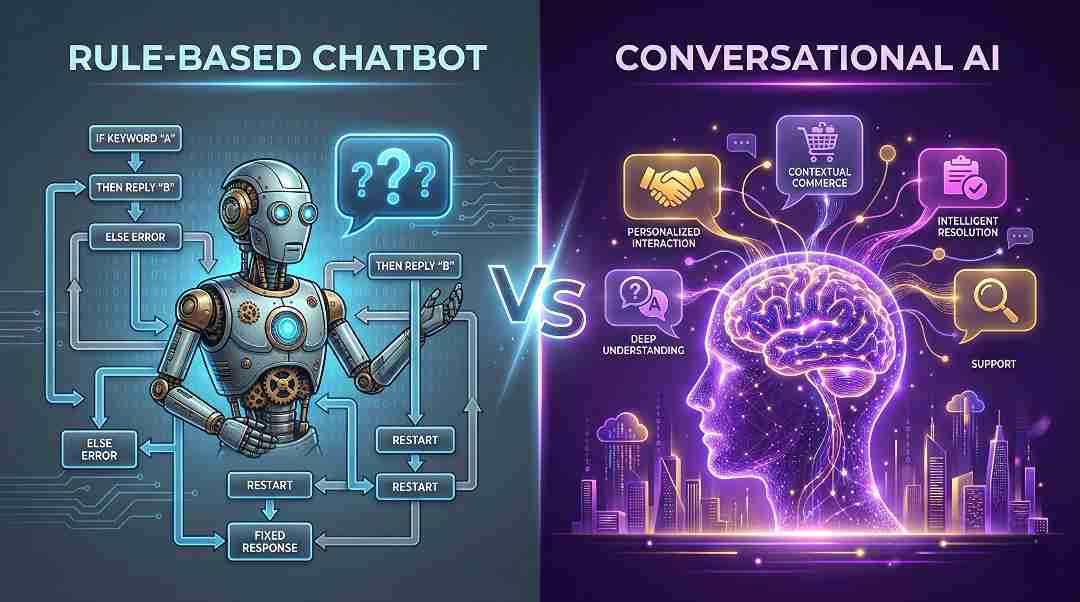
Here is the brutal truth: The gap between Conversational AI vs Chatbot is as big as the difference between a frustrating automated phone menu and a fully trained human assistant.
This guide breaks down the entire comparison in plain English. By the end, you will know exactly which option your business needs and how to avoid wasting thousands of dollars on the wrong tech.
Quick Comparison: The “Cheat Sheet”
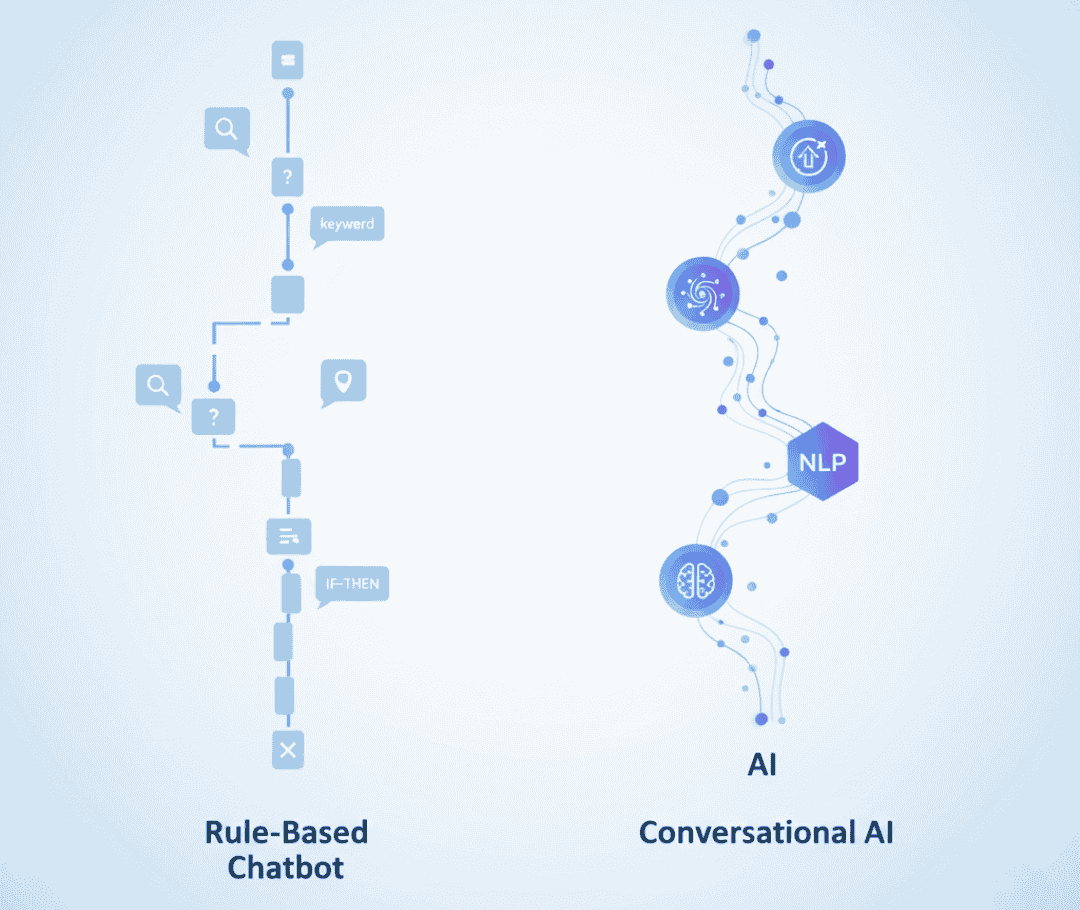
| Feature 🛠️ | Chatbot (Rule-Based) | Conversational AI (Intelligent) |
| The Brain | Follows strict Rules & Keywords (If/Then logic) | Uses NLP & Machine Learning to understand intent |
| Flexibility | Rigid. Can only match exact words. | Dynamic. Understands context, slang, and typos. |
| Memory | No Memory (Every message is new) | Has Memory (Remembers previous context) |
| Conversation | Scripted & Robotic | Natural & Human-like |
| Real Example | “Press 1 for Sales…” or simple Tidio bots | ChatGPT, Siri, or Google Gemini |
| Cost | Low ($0 – $50/mo) | High ($500+/mo) |
| Best For | Simple FAQs & Lead Gen | Complex Support & Enterprise |
What is a Rule-Based Chatbot? (The Basic Bot)
Think of a traditional chatbot like the automated phone menu at your bank: “For Sales, press 1. For Support, press 2.”
Think of it as a basic but obedient soldier. Instead of thinking for itself, it follows a fixed script perfectly, doing only exactly what you have explicitly programmed it to do.
Chatbots are predictable and reliable for simple, repetitive tasks, but they are not “smart.” They cannot think outside the box.
How Chatbots Actually Work
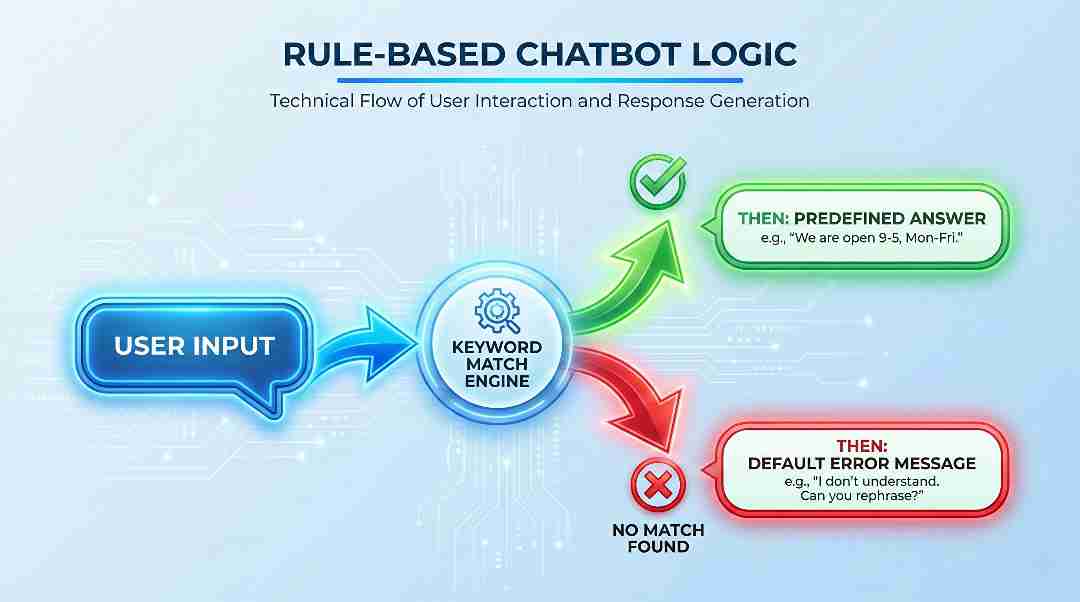
Under the hood, a simple chatbot runs on a “Decision Tree” (Flowchart) or “Keyword Match” logic.
You design the rule:
“IF user types ‘hours’, THEN reply ‘We are open 9-5’.”
- The Problem: If the user types “What time do you close?” or “Are you open right now?”, the bot breaks. It doesn’t understand the question because it is only looking for the exact keyword “hours”.
This is the primary difference in the conversational AI vs chatbot debate: a chatbot matches keywords; it does not understand intent.
Tools like Tidio or Landbot are excellent examples of powerful, modern rule-based chatbots.
Pros of Chatbots
- Affordable & Fast: You can build and deploy a simple chatbot in one afternoon without writing code.
- 100% Reliable: For simple FAQs (like “What is your location?”), it gives the correct answer every single time. No hallucinations.
Cons of Chatbots
- No Memory: Every message is treated as a new conversation.
- You: “What’s the price?”
- Bot: “$50.”
- You: “Does that include shipping?”
- Bot: “I don’t understand ‘that’.”
- Easily Breaks: It cannot handle spelling mistakes or slang. If a user asks a question that isn’t in your script, the bot hits a dead end.
The Verdict: For 90% of local businesses, a simple chatbot is actually the perfect solution. If you want to build one for free, check out our step-by-step guide:How to Build an AI Chatbot for Local Business.
What is Conversational AI? (The Intelligent Bot)
Conversational AI is the brain behind systems like ChatGPT and Google Gemini. Unlike a basic chatbot that follows a strict map, Conversational AI doesn’t need a map. It has a brain.
Think of it as a digital team member, not a script. It doesn’t just match keywords; it figures out what you mean, even if you spell it wrong or use slang.
- Understands Context: It remembers what you said 2 minutes ago.
- Learns Over Time: It gets smarter the more it talks to people.
- Handles Real Language: It speaks like a human, not a robot.
How Conversational AI Works
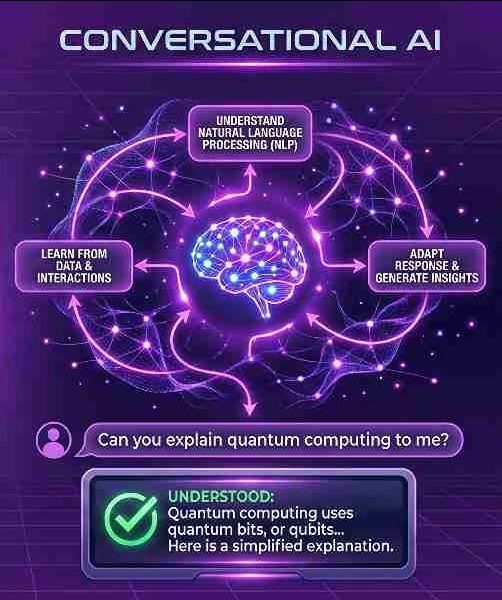
Under the hood, it uses technologies like NLP (Natural Language Processing). But in simple terms? It reads between the lines.
For instance, take the word ‘Bank’. Are you talking about the side of a river or a financial institution? Instead of getting confused by the double meaning, the AI scans the entire sentence to pinpoint your exact intent.
Real-World Example:
Let’s see how both bots handle a vague complaint.
User says: “It’s freezing in here.”
- Basic Chatbot: “I do not understand ‘freezing’. Please select from the menu.” (Fails because “freezing” isn’t a keyword in its script).
- Conversational AI: “Understood. I will raise the thermostat by 2 degrees.”
Why did it work? The AI recognized that:
- “Freezing” = Cold.
- The user wants warmth.
- The solution is the thermostat. This is the intelligence you pay for.
Conversational AI is the powerful technology behind advanced systems like ChatGPT, Google’s Dialogflow and IBM Watson.
Pros of Conversational AI
- Context Awareness (The “Memory” Factor): It remembers details from earlier in the chat.
- You: “Book a flight to NYC.”
- AI: “When?”
- You: “Next Tuesday. What’s the weather there?”
- AI: (Knows “there” means NYC, not your current location).
- Handles Complex Scenarios: Perfect for troubleshooting tech issues, recommending products, or handling angry customers with empathy.
Cons of Conversational AI
- Expensive: A fully trained system is an investment. It can cost thousands of dollars to setup.
- Requires Training: You can’t just “turn it on.” You need to feed it data (past logs, manuals) so it knows your business.
Conversational AI vs Chatbot: Which One Do YOU Actually Need?
This is the moment of truth. Making the wrong choice in the Conversational AI vs Chatbot debate doesn’t just cost you money; it costs you frustrated customers.
Here is the 100% solution to help you decide right now.
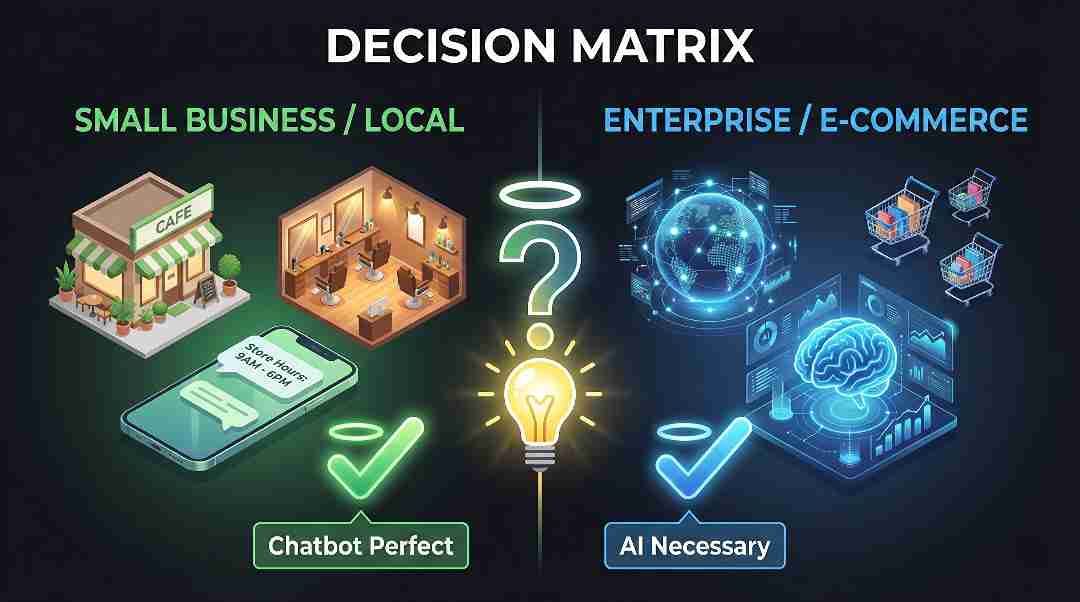
Choose a “Rule-Based Chatbot” IF:
- You are a Local Business (Restaurant, Salon, Clinic, Plumber).
- You handle 10–20 simple, repetitive FAQs (e.g., “What are your hours?”, “Where are you located?”, “Send me the menu”).
- You are working with a tight budget ($0 – $50/month) and need a solution live this week.
The Verdict: A Chatbot is perfect for basic automation and simple, predictable questions. Don’t overpay for AI you don’t need.
Choose “Conversational AI” IF:
- You are an E-commerce Store, SaaS, or Enterprise.
- You deal with complex, multi-step queries (e.g., “My order is late, can I get a refund or store credit?”).
- You have a budget for setup ($500+) and need a system that learns from data to reduce support tickets by 50%+.
The Verdict: Conversational AI is an investment in Customer Experience (CX). If you have high volume and complex problems, it pays for itself.
FAQs: Common Questions About Chatbots & Conversational AI
No, they are not the same. A traditional “Chatbot” is usually rule-based, meaning it follows a strict script (like a phone menu). Conversational AI is the technology (NLP) that allows a bot to understand human language, slang, and context without a script.
ChatGPT is a form of Conversational AI. It uses Large Language Models (LLMs) to understand and generate human-like text. It does not follow a pre-written flowchart like a standard customer service bot.
Rule-Based Chatbot is significantly cheaper. You can build one for $0–$50/month using no-code platforms. Conversational AI is an enterprise-level investment that often costs thousands of dollars for setup and training.
No. A rule-based chatbot has no memory or learning capability. It will make the same mistake 100 times until you manually update its script. Only Conversational AI uses Machine Learning to get smarter over time.
Not anymore. Most modern tools (like Tidio or ManyChat) use “Drag-and-Drop” builders. You can set up a functioning bot in about 30 minutes without writing a single line of code.
Ready to Choose the Right Technology?
Stop guessing.
Tell me about your business in the comments below:
- What do you sell?
- What is the #1 question customers ask you?
Drop a comment, and I’ll reply with my personal recommendation on whether you need a simple Chatbot or full AI, so you never overspend again.
Want more expert insights on automation? Explore Our Full Library of AI-Powered Business Guides on HALearnix to turn your website into a 24/7 sales machine.
