


ChatGPT Study Hacks for Engineering University Students That Cut Study Time in Half (2026)
Nobody warns you that engineering is a completely different level of hard. It is the kind of hard that makes you question your life choices at 2 AM while staring at an impossible differential equation. But you do not have to keep struggling. If you are looking for a smarter way to survive the syllabus, these proven ChatGPT study hacks for engineering university students are exactly what you need right now.
You signed up for engineering because you wanted to build things. Solve real problems. Maybe design a bridge, write intelligent code, understand how engines breathe, or figure out why circuits behave the way they do. What nobody told you was that before any of that happens, you would spend years drowning in calculus, thermodynamics, lab reports, coding assignments, and a syllabus that somehow adds more pages every time you look at it.
If you are nodding right now, this guide was written specifically for you.
These ChatGPT study hacks for engineering university students are what your senior year self wishes someone had handed you on day one. Not tips. Not vague advice like “study smarter not harder.” An actual working subject-by-subject AI study system that thousands of engineering students are quietly using in 2026 to finally understand the material, save hours every week, and walk into exams with actual confidence.
The top students in your class already figured this out. The ones passing with strong GPAs while somehow still having a life are not naturally smarter. They built a better system. While they use the best AI tools for university students to handle specific math or finance problems, the absolute core of their entire workflow in 2026 has one name ChatGPT.
Not as a shortcut. Not to copy-paste assignments. As the always-available, never-impatient AI study partner that explains thermodynamics at midnight, generates practice MCQs at 6 AM, and debugs your Python code in seconds. If you have not used it yet, start at ChatGPT by OpenAI.
By the time you finish reading you will have a complete six-part study system, a one-hour daily workflow, and ten copy-paste prompts ready to use tonight.
Let’s get into it.
Why Engineering University Students Struggle With Studies
There is a need to make a highlight of something that lacks a full understanding of people who do not identify with the profession of engineering.
Engineering is not just a tasking subject, it is one of the most strict courses that one can have. In turn, such rigor results in high rates of dropouts and the related stress load. Besides, in cases when one notices that he/she continues to be behind his/her peers even though they seem to have understood the matter, the bewilderment one faces can also be explained in terms of rationality.
It is not an issue that is personal but the system itself is a demanding one.
The explicit analysis of the reasons engineering students encounter all these challenges is provided below, and, more crucially, how artificial intelligence is increasingly helping to combat each of these problems in a practical and tangible way. This is why ChatGPT study hacks for engineering university students have become so popular in 2026.

1. The Syllabus Never Stops Growing
Look through any engineering course outline and you would find that the breadth of material that is needed is immense. Mechanics, thermodynamics, electronics, mathematics, which most people will have hardly heard of, programming languages, materials science, fluid dynamics, circuit theory all those must be mastered. This is only the first two years of study.
The study of engineering does not center on comfort, but on the abilities that one should have as a professional engineer. As a result, it is heavy, technical, and brutal throughout the entire first week.
The scholastic stress inherent in this massive amount of work is not just a hypothetical one. There is a consistent empirical evidence that engineering students bear some of the largest academic load of any university subject. It is physically demanding to be as proficient with six subjects, at the same time, each of which has its assignments, laboratory sessions, and examinations schedule.
How ChatGPT is useful. You may ask ChatGPT to summarize a whole idea in five minutes rather than wasting three hours attempting to grasp a single chapter from a textbook that was obviously prepared for those who already understand the subject. Not an uninteresting summary, but a comprehensive, multi-layered explanation that, once you have the starting point, you may expand upon. It speeds up the processing of new information without sacrificing the learning process itself.
2. The Ideas Are Actually Complicated
There is a difference between something being challenging because it needs practice and something being challenging because it requires a major shift in how your mind perceives the world.
Engineering concepts often fall into the second category.
Knowing how a Laplace Transform works is not equivalent to recalling some historical date.
It forces one to think of multiple abstract concepts simultaneously, and to find out how they interrelate.
Concurrent consideration of systems which involve inputs, outputs, losses and efficiencies is required in order to understand thermodynamic cycles.
Engineering is a technical problem, solving discipline where memorizing is not enough – it deals with developing a style of thinking which is alien to most people at first.
And it is exactly where students are vulnerable to losing head. They read the chapter. They attend the lecture. Still, they do not grasp it. Moreover, they do not always know how to ask the right question to correct this.
How ChatGPT helps me I can keep throwing the same question at it from different angles until I really get it. I can just say, “I still don’t get this, explain it another way” and there is no awkwardness. I can even request a real life example, or ask it to relate a new concept into something I already know from a lecture. This is a flexible, personalized help that nothing on a textbook can provide, and professors can’t really give me that kind of one to one attention.
3. There always exists an uncompromising time pressure
Engineering students are not allowed to be idle for long.
Between lectures, lab sessions, tutorials, assignments, group projects, and examination preparation the calendar is permanently filled. Unlike some other fields of study where it’s possible to catch up on a weekend, getting behind in the engineering field is a double-edged sword. Missing the basic content of a topic makes the next three topics that build on it more and more difficult to understand. Falling behind in one subject thus loses the time needed by another subject.
The pressure to time experienced by engineering students is not a result of poor time management; rather time management is an outcome of the structural demands of the stringent nature of the degree.
ChatGPT helps: The biggest time buster for most engineering students is not the work itself – it’s the confusion that precedes starting the work. Stuck on an exercise for 45 minutes, no idea how to start? Re-reading the same paragraph 4 times, in the hope that it suddenly makes sense? ChatGPT fvremoves that period of being stuck. You get something to start you off, a direction to go in, a framework within minutes, and the real productive work can start right away instead of an hour of torture.
4. Balancing Theory and Practical Work at the Same Time
Engineering degrees do not offer the option of choosing between understanding concepts and using them, one must do both simultaneously and continuously.
For instance, a morning may begin with a lecture in pure mathematics of Fourier series. An afternoon might include a laboratory session which requires the application of principles which have not yet been fully mastered. The evening may end up with an assignment that requires both to be integrated.
Such constant back and forth between theoretical understanding and practical application is tiring, in a way that is hard to explain to people not involved with the programme. It is not just a matter of busy-but involving a matter of functioning in 2 fundamentally different ways of relating to the world on a daily basis.
How ChatGPT helps I’ve found that ChatGPT really bridges the gap between theory and practice and it really can’t do that with traditional studying. If you’re working on a lab project, just tell ChatGPT what you’re trying to do and it’ll bring the applicable theory back into the conversation. Or if you’re stuck on a pure math concept you can ask it a practical scenario in engineering where that math pops up. That link that between the equation on the board and the real-world system it’s actually describing, ChatGPT is able to lay out and illustrate in a matter of seconds.
How Engineering University Students Use ChatGPT to Study
Just being aware of what ChatGPT is and actually knowing how to properly use it are two two completely different things.
Most of us open it, type a vague question, receive a confusing answer and quickly conclude that it’s not that helpful. That’s not a problem with ChatGPT, that’s a problem with prompting. How you ask the question determines completely the quality of the answer you receive.
This section outlines the step-by-step on how to use ChatGPT to approach the most common and difficult tasks that you’ll face as an engineering student – all complete with actual prompts to try tonight.

Break Down Complex Engineering Concepts
The first ChatGPT study hacks for engineering university students is concept simplification. All engineering students are fighting with one subject that is hard to consider.
The student can also listen to the lecture, read the chapter, and watch a tutorial video; however, the idea seems to stay very close to the understanding but not enough to avail in solving problems.
This exasperating situation encircles the engineering university where it is experienced in all students regardless of their intelligence or hard work. Some of the ideas are simply abstract and not designed to be quickly understood but precisely technical, akin to the dissimilar ease of learning.
This is the case with the Laplace Transform. It is one of the most important mathematical tools in engineering and can be found in control systems engineering, signal processing engineering, electrical circuits and mechanical vibrations engineering. However, initially, when the majority of students are introduced to it, the descriptions that they get are too mathematical and, as a result, the actual essence of the tool gets lost under the notation.
ChatGPT finds real application in this respect but not as a time saver but rather as an idea translator. It translates engineering jargon of mathematics into simple English that can easily be digested by the mind. In the case when the concept is clearly understood, the mathematics which follows after the concept becomes considerably much easier to work with.
Take this into account: a textbook will include the most technically accurate explanation, and ChatGPT will introduce the most understandable one, and then the learner can further become more technical. This sequencing would be quite effective to the majority of the students compared to the reverse.
The same method can be adopted with any tough subject in the engineering subject. ChatGPT can offer a clear and simple point of departure in two minutes whether that is of thermodynamic concepts, e.g. entropy and heat-transfer cycles, of mathematical concepts, e.g. Fourier series and complex numbers, or of electrical concepts, e.g. impedance and resonance.
Try This Prompt Right Now
Five minutes with this prompt will give you more usable understanding than an hour of rereading a chapter that was not written with a first-time learner in mind. For deeper reading on any mechanical or electrical topic, MIT OpenCourseWare offers completely free university-level engineering materials used by students worldwide.
How to Solve Engineering Problems Step by Step Using ChatGPT
There is no denying that understanding a concept and solving a problem is a large distinction between two skills. It can be memorized because of a lecture, a chapter read, and still be completely blank when one opens an assignment. This is a factor exhibited among almost all engineering students. It does not mean that one lacks intelligence but only means that one has not been practicing bridging the gap between theory and action.
This is the point, where ChatGPT will transform the learning process of engineering students. Instead of wasting forty minutes staring into a blank screen at a problem, solutions one might come up with can be expressed in plain English in steps. ChatGPT also works as a tutor when I ask to have the formula explained in detail and follow the actual logical order of steps. It is not just a source of teaching the ultimate answer, but rather teaching the learner on how to reason out the problem.
As a result, this is what most of the students are indeed lacking.
Prompt Formula Explanation:
The Concept Mastery Prompt
Always Verify Your Solutions
ChatGPT is a brilliant study tool, but it still struggles with multi-step mathematics and complex scenarios. It will confidently spit out the wrong number. Treat it as a thinking partner to understand the logic and method, not as a final answer key. You are ultimately responsible for your final result.
Solution Verification Prompt
Never use a ChatGPT answer in graded work without checking it first. Cross-check every numerical answer using Wolfram Alpha the most reliable free calculation and formula verification tool available to engineering students right now.
Three Prompts For ChatGPT To Create Study Notes in Seconds
Paul’s Online Math Notes for engineering mathematics.
Best ChatGPT Prompts for Engineering Exam Preparation
- In fact, combining this ChatGPT workflow with dedicated math solvers is one of the most effective engineering exam preparation tips you can use to ensure you never blank out during your midterms.
Turn ChatGPT into AI Programming Assistant
official MATLAB documentation by MathWorks.
Write Perfect Lab Reports: Prompts for Assignment Structure Help
Find verified research sources on Google Scholar.
Daily ChatGPT Study Workflow for Engineering Students
This daily workflow is built specifically around ChatGPT study hacks for engineering university students who want structure without wasting hours. Most engineering students struggle not because of poor study habits, but due to a lack of effective structure.
They find their seats and study, open five browser tabs, devote twenty minutes to deciding where to focus their attention, get frustrated, and spend an hour before they can do anything productive. At the end of the session, the feelings of guilt are more likely than actual progress.
Instead of studying longer, students should use a structured system that removes decision-making, encourages focus, and enables productive work throughout each session.
This ChatGPT-powered study routine takes 1 hour every day. It involves the understanding of concepts, problem solving, review practise, including everything in each lesson.
visualise equations using Desmos.
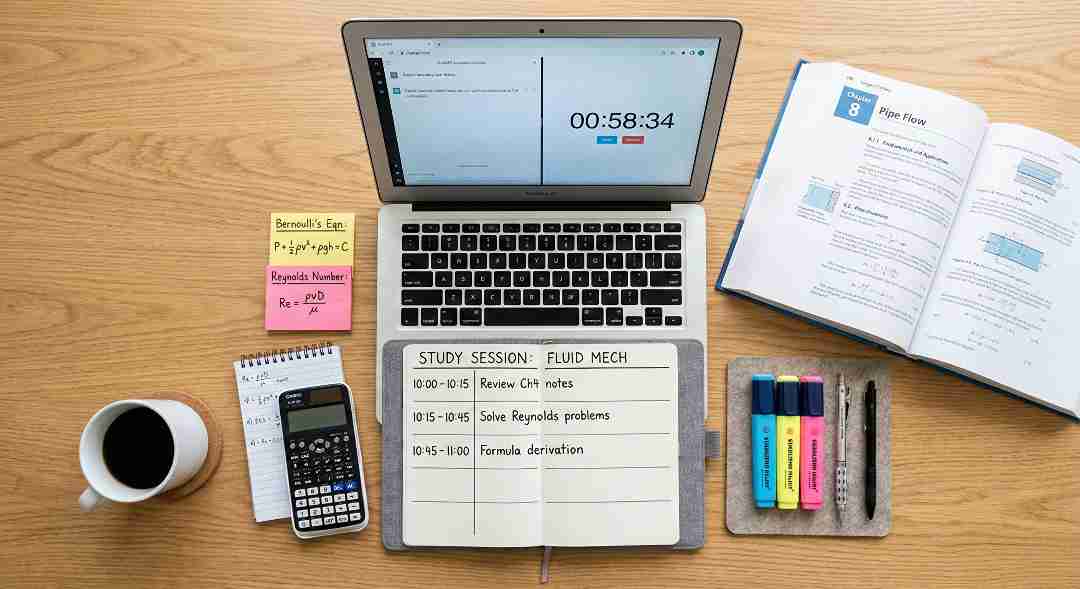
The 1-Hour ChatGPT Smart Study System
Minutes 1 to 10 – Concept Simplification
Pick one topic from today’s lecture. Ask ChatGPT to explain it in plain English with a real example. Do not move forward until it makes sense.
Minutes 11 to 30 – Problem Solving
Take one problem from your assignment or past paper. Try it yourself first. Then ask ChatGPT for the full step-by-step solution. Compare. Understand every step you got wrong.
Minutes 31 to 45 – Practice Questions
Ask for five exam-level questions on the same topic. Answer them with notes closed. This single block is what moves information from short-term memory into actual exam recall.
Minutes 46 to 55 – Summary Notes
Ask ChatGPT to summarize the full session in ten bullet points. Save it. These become your revision notes in the days before exams.
Minutes 56 to 60 – Doubt Clarification
Use the last five minutes to clear every small question. Clear confusion now before it becomes a bigger gap next week.
Best ChatGPT Prompts for Engineering Students
ChatGPT does not simply give you the good results it gives you; rather, good results are the way you pose the question.
It will be aimed at the engineering undergraduates using the following prompts: All of them are accurate, well tested, and capable of operation at present time.
All you need to do is copy them and replace them with the brackets with whatever you are writing about and you will be doing much better in a few seconds.
These prompts work best when you understand how to use AI strategically. If you want to go deeper, check out this complete ChatGPT prompt guide for students, it shows you how to turn AI tools into real income-generating skills, not just study shortcuts.
1. Understand Any Difficult Concept
2. Master Thermodynamics Laws
Engineering Toolbox reference.
3. Solve Problems Step by Step
4. Generate Circuit Analysis MCQs
5. Debug Python or MATLAB Code
6. Simplify Complex Mathematics
Free differential equations practice on Khan Academy.
7. Create Exam Revision Notes
8. Prepare for Viva Questions
9. Structure a Lab Report
10. Build a Full Study Plan
One Rule Before You Use These
Every prompt works better when you add your year, your subject, and your current knowledge level. The more context you give ChatGPT the more useful and accurate the response.
These ten prompts cover concept understanding, problem solving, exam preparation, coding, lab reports, and revision every core challenge engineering university throws at you, handled in one place.
Save this section. You will come back to it before every exam.
Ethical Use of ChatGPT in University
ChatGPT is the latest and best study tool to us engineering students. But just as any hype gear, it all depends on the way that you wear it, whether it will contribute to you or not.
This part is very brief as the regulations are not complicated. Read it and keep it in mind the next time you open ChatGPT to do university assignments.
IEEE guidelines on ethical use of technology.
Do Not Copy-Paste Into Assignments
Using ChatGPT to understand a concept is completely fine. Copying its response directly into your assignment and submitting it as your own work is academic. Most universities now use AI detection tools. The consequences range from a zero on the assignment to permanent academic record damage.
It is not worth it. Especially when using it the right way gives you far better long-term results anyway.
Use ChatGPT to Understand the Concept, Not to Replace Your Thinking
The entire value of ChatGPT for engineering students comes from using it as a learning tool. Ask it to explain and guide in easy way, then break things down until they make sense.
That is what AI is taught but doing what you study in practise is what helps you pass exams, vivas, and into a proper engineering career in the end.
Always Check the Accuracy
ChatGPT is not a textbook, literally. There is no quality-control division and therefore it may come up with a confidently spoken answer which may indeed be having a miscalculation, formulation or an old method.
That’s not a reason to avoid it. However, you are still advised to cross-cheque all your numerical solutions and technical statements with your course work,textbook, or a credible source such as the Wolfram Alpha before incorporating it in anything that is graded. This will help you to avoid sharing mistakes in the assignments.
Understand Your University’s AI Policy
Every university currently handles ethical use of AI in university differently. Some allow AI tools for research and understanding, restrict them entirely for assessed work. Most of require you to declare AI use in your submissions.
AI safety research by Anthropic.
Check your university’s academic integrity policy before your next assignment. Knowing exactly where the line is protects you completely.
Common Mistakes Engineering Students Make Using ChatGPT
ChatGPT is a powerful engineering study tool, but it can quickly ruin your grades if you fall into these four common traps:
- Blindly Trusting Every Answer
ChatGPT sounds 100% confident, even when it is completely wrong. It will not warn you when it is guessing. If you blindly trust its responses without questioning the logic, you will carry those mistakes straight into your exams. Always read critically. - Skipping the Verification Step
Never use an AI-generated answer in your graded work without checking it first. Always verify formulas with your official course notes, and double-check numerical math using a calculator or Wolfram Alpha. Treat ChatGPT as a rough draft, never the final authority. - Becoming Lazily Dependent
There is a massive difference between getting unstuck and letting AI do the thinking for you. If you ask for the solution before even attempting the problem, you skip the “productive struggle” that actually trains your brain to be an engineer. Always try the problem first. Use ChatGPT second. - Asking Vague Questions
Vague questions give you vague answers. Asking “Explain thermodynamics” just spits out a boring textbook summary. Instead, be highly specific: “Explain the second law of thermodynamics using a car engine analogy for a second-year mechanical engineering student.” Better prompts instantly create better study sessions.
Can ChatGPT Study Hacks Improve Your Engineering GPA
Many engineering university students using ChatGPT study hacks have reported stronger exam performance within weeks. The short answer is yes, but only if you use it the right way. Explore these proven strategies to improve your engineering GPA and see how smart AI use translates into real academic results.
The outcome will be made clear to us once we religiously go through the material with the help of ChatGPT. When we apply it in deconstructing difficult ideas, practicing our end-examinations, clarifications of the troublesome same-night that they occur, and create systematic revision-aids, we are performing better study than the typical student around us. The consistency is reflected in our grades.
These are realistic tips to improve GPA that actually work since they address the actual cause of most engineering students under performing, and that is the absence of clarity and not hard work. No other tool that a student currently has can clear his confusion better than ChatGPT does. When we understand fewer issues, then we make attempts at more problems. Greater number of problems attempted results in high performance in exams, which reflect on high grades.
No – If You Use It as a Shortcut
Unless you are utilising ChatGPT to simply copy assignment answers, avoid the real thinking, or avoid the difficult aspects, your GPA will not improve. It’ll actually drop.
Here’s why. All the engineering finals are about whether you are able to handle the issues yourself when the clock is ticking. In case ChatGPT does all the heavy work in your preparation, you fail to develop that and the exams reveal that immediately.
Although short cuts may appear convenient in the mean time they strike you at the right moment when you need them.
The Honest Reality
ChatGPT does not improve your GPA. Your consistency does. ChatGPT simply makes consistent quality studying faster, clearer, and more accessible than it has ever been before.
Use it to understand more in less time. Show up to every exam having genuinely worked through the material. That combination is what moves your GPA in the right direction.
Future of AI in Engineering Education
The way engineering is taught is changing faster than most universities are ready to admit.
AI is no longer just a buzzword in engineering, it’s becoming the most powerful tool in every engineer’s toolkit. From automating complex calculations to writing code in seconds, the transformation is real. See exactly how students are using it right now with these best AI tools transforming engineering education and start building tomorrow’s skills today.
ChatGPT is just the beginning. The students using AI study tools today are not just improving their grades right now, they are building familiarity with a learning model that will define engineering education for the next decade.
Explore engineering courses on Coursera.
Personalised AI Tutors
Right now ChatGPT responds to everyone the same way. The next generation of AI study tools will know your weak topics, track your progress, adjust explanation difficulty based on your responses, and build a study plan around your specific gaps.
Imagine a study assistant that remembers every concept you struggled with last week and automatically revisits it before your exam. That technology is closer than most students realize. The engineering students who are already comfortable working with AI tools today will adapt to these advanced systems immediately while others are still figuring out the basics.
Smart Simulations
Engineering education has always had one major limitation physical labs are expensive, time consuming, and only available during scheduled hours.
AI-powered smart simulations are beginning to remove that limitation entirely. Virtual environments where you can test a circuit, run a thermodynamics cycle, or simulate structural load behaviour from your laptop at midnight with real-time feedback on every variable you change. This kind of interactive learning produces deeper understanding than reading about the same concept ever could.
Several leading engineering universities are already piloting these systems. Within a few years they will be standard.
AI-Generated Practice Labs
One of the hardest parts of engineering exam preparation is finding enough quality practice material. Past papers run out. Textbook questions repeat. Practice becomes limited by how much material exists.
AI-generated practice labs solve this completely. Unlimited unique problems generated at your exact difficulty level, in your specific subject, matched to your current syllabus. Every attempt gives you a fresh challenge built around the same core concepts your exam will test.
For ChatGPT study hacks for engineering university students this is the natural next step, moving from static prompts into fully dynamic practice environments that adapt in real time.
Hybrid Human and AI Learning Model
AI is not replacing professors in terms of the future of engineering degrees. It is regarding creating a smarter hybrid human + AI model of learning that we, being students, can practically apply.
Instead of a human being doing such a job, AI intervenes and appears to be at 3am, capable of decomposing complicated theories, and regurgitating indefinite practise issues when needed. I
Yet AI can never make you understand the emotional experience of being in the profession. Professors provide us with the on-the-job experience, mentorship in an industry, and practical career advice that can not be artificially generated by any programmes.
The most intelligent among us is now putting our education through a two step system, as we apply AI to immediately get academic assistance and we trust our professors to guide us professionally.
When we learn how to strike the balance of this hybrid system in our time then we will graduate much better prepared to face the end product than all previous generations.
Frequently Asked Questions About ChatGPT for Engineering Students
These are the most common questions engineering university students ask about ChatGPT study hacks.
Yes, when used correctly it is one of the most effective study tools available to engineering students right now. ChatGPT explains difficult concepts in plain English, generates practice questions on demand, solves problems step by step, and is available at any hour.
It can, but not always perfectly. ChatGPT handles conceptual explanations and standard problem solving very well. However it can make arithmetic errors in complex multi-step calculations and occasionally applies formulas incorrectly in specific contexts. Always verify numerical answers against your textbook or Wolfram Alpha before using them in any graded work.
It depends entirely on how you use it. Using ChatGPT to understand concepts, practise problems, generate revision notes, and prepare for exams is not cheating. It is smart studying. Copying ChatGPT responses directly into assignments and submitting them as your own work is academic misconduct. Universities now have AI detection tools that identify this.
Every major benefits, but the use cases vary. ChatGPT takes overwhelming coursework and turns it into manageable, bite-sized lessons across all fields:
Computer Science & Software: Best for debugging broken code and mastering complex algorithms.
Mechanical Engineering: Simplifies thermodynamics, statics, and fluid dynamics.
Electrical Engineering: Helps with circuit analysis, signal processing, and systems theory.
Civil Engineering: Breaks down structural analysis and material science concepts.
No matter your branch, the core value remains the same: ChatGPT makes the most complex engineering subjects approachable and easier to digest.
The most effective prompts for exam preparation include asking ChatGPT to generate practice questions at exam difficulty, simulate viva questions with model answers, create a one-page revision summary of a topic, and walk through past paper problems step by step. The more context you provide the more useful the response becomes.
Yes, and this is one of the areas where it delivers the most immediate value. ChatGPT can debug your code, explain every error in plain English, walk through algorithm logic before you write a single line, and help you understand what your output actually means. Use it to understand the code rather than simply copy it.
Use it as a support tool not a primary source. The right balance is using ChatGPT to remove confusion quickly, generate practice material, and clarify doubts, while doing the actual thinking, problem solving, and exam preparation yourself. Students who rely on it too heavily skip the productive struggle that builds real engineering ability.
Conclusion: Your Smarter Engineering Study Journey Starts Tonight

You came to this guide because engineering felt overwhelming. The syllabus too heavy. The concepts too complex. The nights too long.
Engineering is brutally hard. That won’t change overnight. But starting tonight, you are finally equipped to handle it.
Every ChatGPT study hacks for engineering university students in this guide exists for one purpose. To give you a real, working, practical system that removes the confusion faster, builds your understanding deeper, and gets you to exam day prepared instead of panicked.
You now have everything you need.
You now have everything you need: a complete six-part study system, a one-hour daily workflow you can start tonight, and ten copy-paste prompts. Most importantly, you know exactly how to use ChatGPT ethically to actually learn, not just copy.
The only thing left is to actually start.
One Simple Action Before You Close This Page
Open ChatGPT right now. Pick the one concept that has been confusing you the most this week. Use any prompt from this guide. Spend ten to twenty focused minutes on it.
That one session will show you more clearly than anything written here exactly how powerful this study system is when you actually use it.
Found This Guide Helpful?
Bookmark it – exam season always comes faster than expected and every section here becomes more valuable the closer your exams get.
Share it – every engineering student in your class is facing the same pressure. Send this to one person tonight who needs it.
Drop a comment – which section helped you most or which topic you want covered next. Every response gets read.
